Welcome: ZHAN JIANG ASCEN TECHNOLOGY CO.,LTD
Language:
 ∷

∷
∷
How Heat Stress Affects Boar Semen Quality — And How CASA Sperm Semen Software System Can Catch It Early
Every summer, boar AI centers run into the same problem. Conception rates dip in late summer and early autumn, and by the time anyone notices, the damage was done weeks earlier. Heat stress is one of the most economically damaging — and most poorly detected — threats to boar semen quality.
The reason it catches so many operations off guard is timing. The effects of heat stress do not appear immediately. They show up on a delay, which means the boar that looks fine today may already be carrying damaged sperm that will only become visible in the ejaculates collected five to seven weeks from now.
This article explains how heat stress damages boar semen, why conventional checks miss the early warning signs, and how computer-assisted semen analysis (CASA) can detect the problem while there is still time to act.
Why Boars Are Especially Vulnerable to Heat
The testes and epididymis sit outside the body, relying on airflow across the scrotum for cooling. Pigs have very limited sweating capacity, and the optimal temperature window for boar fertility is narrow. In practice, environmental temperatures above roughly 26–28 °C — particularly when humidity is high and ventilation is poor — begin to affect semen production.
This makes boars more heat-sensitive than many other livestock species. A heat event in the barn is not a minor stressor; it is a direct hit on fertility.
The Three Layers of Heat Stress Damage
Layer 1: Disrupted Spermatogenesis (Delayed, Most Serious)
Sperm production in the boar takes approximately **five to seven weeks** to complete. When heat stress occurs, the sperm cells currently under development are damaged — but their damage only appears in collected semen **weeks later**.
This delay explains a pattern many breeders recognize: a heat wave in June or July produces a fertility crisis in August or September.
Typical presentation:
- Lower concentration
- Higher abnormality rate (head defects, acrosome abnormalities, coiled tails)
- Reduced motility
Layer 2: Immediate Motility Damage
Mature sperm stored in the epididymis are affected directly and quickly. Heat stress reduces their **motility and survival time** within days. The practical consequence is a **shorter fertile window after insemination**, even when concentration looks unchanged.
Layer 3: DNA Integrity
Heat stress generates oxidative stress, which damages sperm DNA. In this scenario, **conventional motility parameters may look normal while DNA fragmentation is already elevated**. These samples appear acceptable on a standard report but quietly reduce conception rates and litter size. This is why leading AI centers are adding DNA fragmentation testing to their quality programs.
Why Visual Inspection and Basic Sperm Quality Testing Miss It
The early signs of heat stress are subtle. Total motility may still sit above the minimum threshold. Concentration may appear largely unchanged. But **progressive motility and kinematic parameters are already drifting** — changes that cannot be detected by eye or by coarse testing methods.
By the time total motility and concentration drop visibly, the damage occurred weeks earlier and the loss is already real.
How to Detect Heat Stress Early with CASA Sperm Software System
The key principle: **do not rely on a single number. Track parameter trends and structural changes over time.**
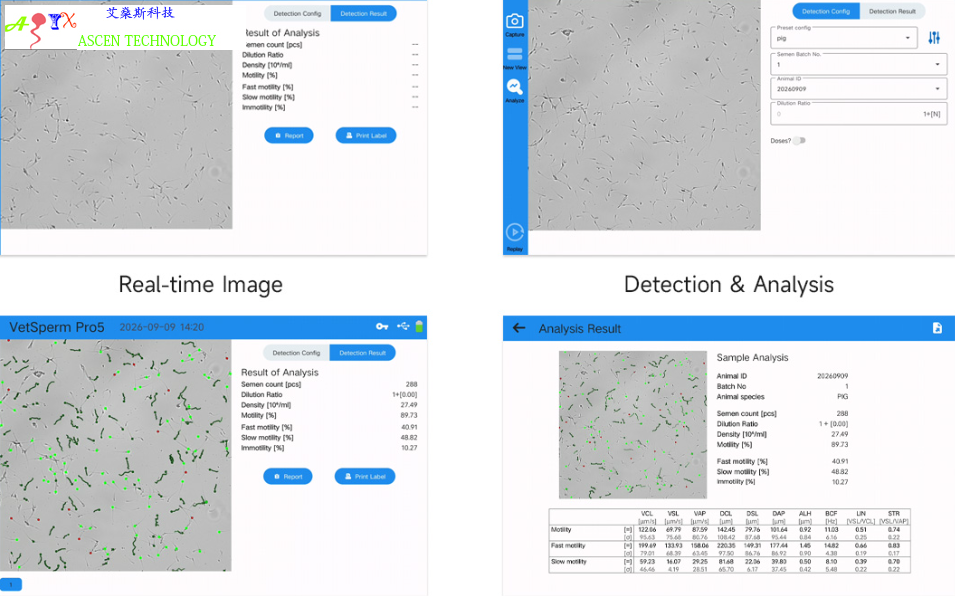
**Track progressive motility, not just total motility.** In early heat stress, total motility holds up while **progressive motility declines first**, because sperm movement becomes less directional — lower VSL, reduced LIN, often elevated ALH, producing a "circling" pattern. Read separately, progressive motility is the more sensitive alarm.
**Track kinematic parameter trends.** VCL, VSL, VAP, LIN, STR — what matters is not a single reading but each boar's **historical baseline**. When a boar's VSL or LIN falls below its own baseline for several consecutive checks — even while still inside the "acceptable range" — it warrants attention. CASA's objectivity and repeatability make it possible to build and monitor these trend lines, which manual counting cannot support.
**Track morphology.** The delayed damage of heat stress appears weeks later as rising abnormality rates. A morphology module captures this and serves as an early warning.
**Build a heat-season monitoring rhythm.** During the hot months, increase testing frequency. Where weekly testing may be normal in cooler periods, high-temperature periods justify testing every batch and logging the correlation between barn temperature and results. If an anomaly appears, you can trace it back to a specific heat event weeks earlier.
Contact: Alex Chan
Phone: 18898665032
Tel: 0752-87966
Email: info@szyessmt.com
Add: 1st Building Floor,No.21,Guang Du Industrial Park ,Zhan Jinag City,Guang Dong Province,China